Urban skylines are changing rapidly. Buildings with 40 to 60 floors are no longer uncommon, especially in large metropolitan cities. While elevator speeds have increased significantly, the actual travel time inside elevators is often longer due to multiple stops and passenger movement in and out of the car.
Elevator manufacturers have made remarkable progress in improving speed, ride smoothness and control systems. However, one element has largely remained unchanged: the standard cabin air circulation blowers.
These blowers are designed to provide quiet air circulation and fresh air exchange inside the elevator cabin. While they perform this function adequately in cooler climates, they are often insufficient in tropical regions like India where high temperature and humidity persist for most of the year.
Passengers today move from air-conditioned homes to air-conditioned cars and offices. In this context, even a short journey inside a non-air-conditioned elevator can cause noticeable discomfort, especially in buildings where elevator lobbies are also not air-conditioned. This growing need for passenger comfort has led to the development of a specialized solution: elevator air conditioners.
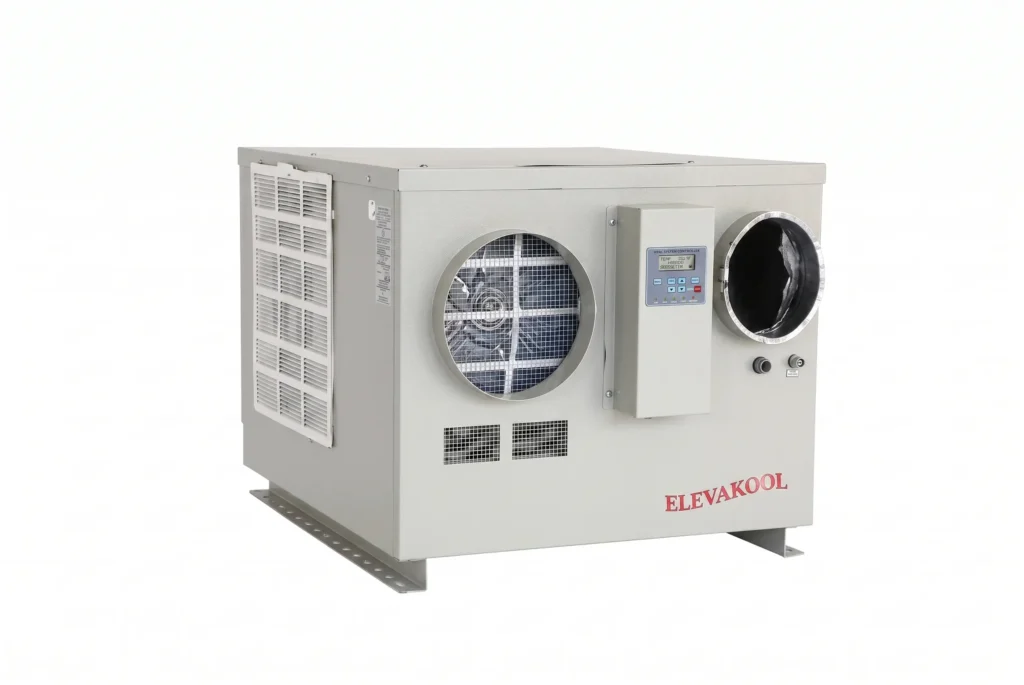
Elevator air conditioners have the following key design
requirements:
♦ Compact Footprint. Elevator car tops already house multiple critical components such as controllers, safety systems and wiring. Therefore, the air conditioner must have a compact footprint that fits within the limited available space without interfering with other equipment.
♦ Low Noise and Vibration. Passenger comfort is paramount. The AC must operate virtually noise-free and vibration-free so that its operation is not perceived inside the
elevator cabin.
♦ Automatic Dehumidification. Humidity control is a critical requirement in tropical climates. The system must include automatic dehumidification to prevent water accumulation and condensation issues.
♦ Intelligent Operation. Features such as weekly scheduling allow the system to operate automatically without requiring daily manual switching
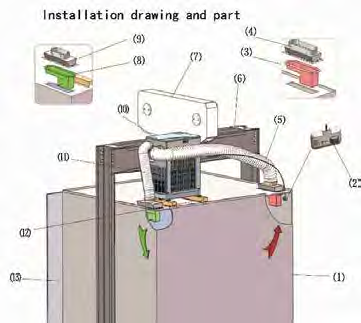
An elevator air conditioner is a niche product specifically engineered for installation on top of a moving elevator car. Unlike conventional air conditioners, these units are designed to operate within the unique constraints of elevator systems, including limited space, vibration sensitivity and safety requirements. While the fundamental cooling principle remains the same — removing heat and humidity from the cabin air — the system is adapted and optimized for elevator applications
♦ Increased corrosion and electronic failures
♦ Reduced equipment life
2)Advanced Water Management System
A more reliable solution uses a dedicated water handling
system, which includes:
♦ Water level sensors
♦ Condensate pumps
♦ Sediment filters
♦ Controlled evaporation process
This design ensures the evaporation rate matches the
condensation rate, while sensors provide complete protection
against water overflow on the car top.
One of the biggest challenges in elevator air conditioning is managing condensation and dehumidification.
During periods such as the early monsoon season, humidity levels in India can exceed 90%. Under these conditions, the rate of condensation inside the AC unit can increase significantly.
If the dehumidification system cannot match the condensation rate, water may accumulate and spill onto the elevator car top. This can damage expensive electronic components and may even lead to major elevator breakdowns.
Different approaches are used to manage condensate water. These include: 1)Basic Evaporation Technique. A simple and low-cost method involves throwing condensate water onto the hot condenser coil using fan blades, allowing it to evaporate. While inexpensive, this approach has several limitations:
♦ No water level monitoring
♦ Uncontrolled evaporation ♦ Possibility of water spillage
♦ Chopping or splashing noise
♦ Water droplets spreading inside the AC enclosure
Elevator air conditioners contain rotating equipment and
water management systems, which require periodic servicing.
Regular maintenance ensures:
♦ Efficient cooling performance
♦ Proper functioning of the dehumidification system
♦ Longer equipment life
♦ Reliable operation without unexpected breakdowns
Therefore, selecting a product supported by a strong service
network is equally important.

Shirish Talwalkar is director of Eleva Tech. He is an electrical engineering graduate from NIT Nagpur and has a MBA from ITM Mumbai. He has 35 years of diverse work experience in leading companies like Johnson & Johnson, Sun Pharmaceuticals, Otis, Mitsubishi Electric and Sematic. In the elevator field, he has worked in the service, installation and sales departments of elevators and elevator components. He served as the Western Region head for Otis and, later, Mitsubishi Electric. After that he was the managing director for Sematic, an Italian company creating elevator doors. He then started the ambitious and future facing Eleva Tech, a dedicated elevator accessory company for Indian products and Indian customers.
To ensure reliable performance, the following factors must
be carefully evaluated:
♦ Proper dehumidification technology
♦ Compact footprint suitable for car-top installation
♦ Professional installation
♦ Strong service and maintenance support
When these factors are addressed correctly, elevator air
conditioning significantly enhances passenger comfort,
especially in high-rise buildings located in tropical climates
Even the best air conditioner will underperform if installed
incorrectly.
The cooled air supplied by the unit is typically 14–15°C. If this
cold air comes into contact with metal surfaces before entering
the cabin, condensation can form, leading to water droplets
falling onto the car top or elevator panels.
Proper installation must therefore ensure that:
♦ Cold air is directly delivered into the cabin.
♦ Air ducts avoid contact with metal structures.
♦ Condensation risks are minimized.